


GRYD Halo - Red Light Therapy Cap for Thinning Hair
GRYD Halo - Red Light Therapy Cap for Thinning Hair
From fewer hairs in the shower to a fuller-looking parting, one quiet session at a time.
Clinic-style red light therapy at home, compared to £500+ for 6 clinic sessions.
142 LEDs at 660nm red and 940nm near-infrared, covering the crown, hairline and temples
Designed to support thicker, fuller-looking hair with consistent use
Cordless and hands-free: set it with the remote, sit back, and it switches off automatically
Under 250g with an adjustable fit, and it looks like an everyday cap
2-year warranty, 60-day returns and a UK team you can reach out to
Couldn't load pickup availability
Try it for 60 days. If it’s not for you, send it back. Covered by a 2-year warranty and UK-based support.
- Apple pay payment method
- Google pay payment method
- Shopify pay payment method
- Klarna payment method
- Visa payment method
- Master payment method
- Paypal payment method
- American express payment method
- Discover payment method

GRYD Halo - Red Light Therapy Cap for Thinning Hair
-

"After the 17th day, I can confidently say that I am positively surprised. The product actually works. I notice less hair on my hands when I run them through my hair in the shower. I use it once a day for 10 minutes. I will continue using it in the future as I have seen results so far."
-

"I've been using the cap for a month, with 3 sessions a week of 20 minutes each, and results are starting to show. I've started to grow hair in the lighter areas."
-

"The cap is very comfortable to wear, it's not too hot, and it doesn't compress on your head (has adjustable sizing)"


What's Included?
What's Included?
GRYD Halo cap · Remote control · USB charging cable · Quick-start guide
Key Features
Key Features
142 LED bulbs, full scalp coverage - evenly distributed across the crown, hairline, and temples, no repositioning needed
Dual-spectrum red (660nm) and near-infrared (940nm) light - red works at the scalp's surface, near-infrared reaches slightly deeper, working together to support circulation and follicle activity
Five adjustable intensity levels - start gently and build up as your scalp adjusts
Customisable timer, up to 30 minutes - set your session length; Halo switches off automatically when time is up
Fully cordless and hands-free - rechargeable 2600mAh battery, remote-controlled, no cables or holding required
Lightweight, adjustable-fit design - under 250g with an adjustable strap for a comfortable, secure fit
Rated power ≤12W - low enough for safe, everyday use as part of a normal routine
Delivery & Returns
Delivery & Returns
Delivery: We offer free tracked delivery on all orders. Orders arrive within 4–9 days. For full details, refer to Shipping Policy.
Returns: Items can be returned within 60 days of delivery if unused and in original condition. For more, please review our Return & Refund Policy.


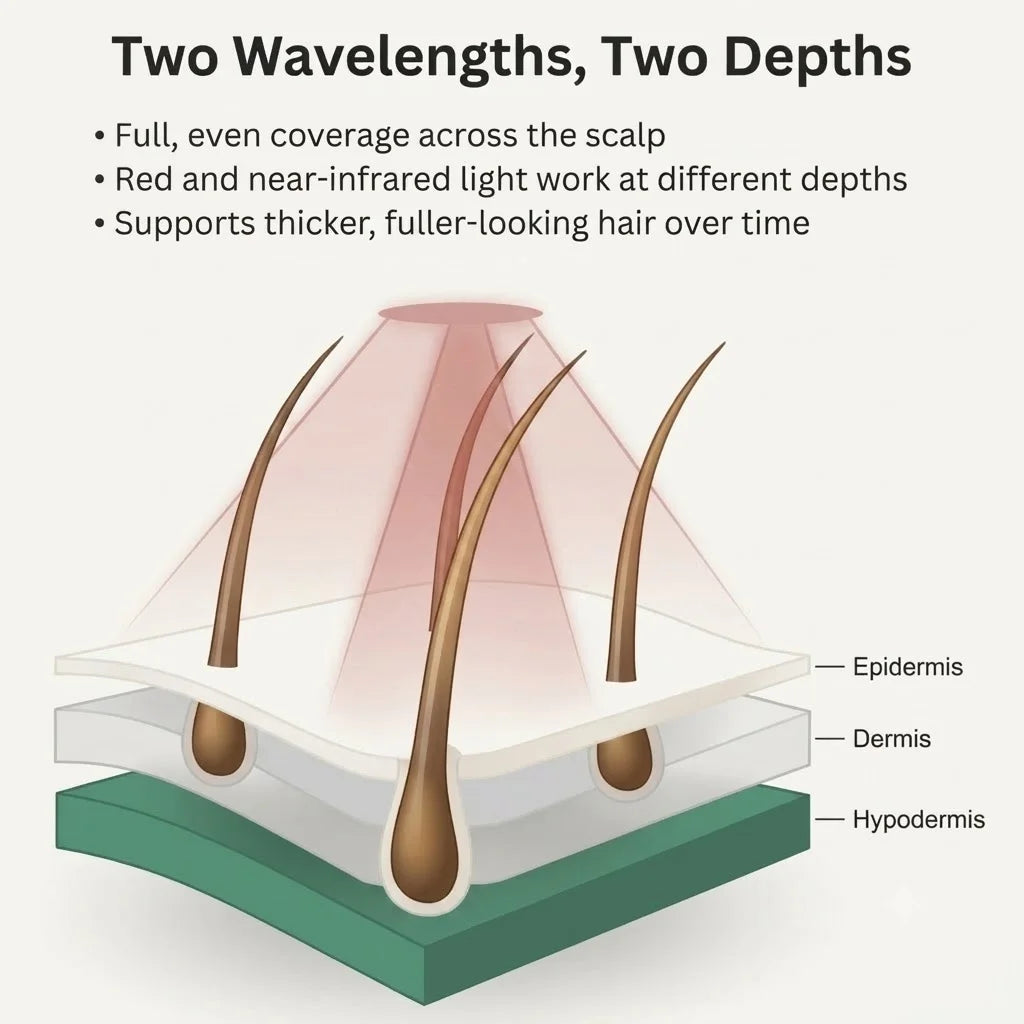

How GRYD Halo Works
Halo uses a process called photobiomodulation. Red (660nm) and near-infrared (940nm) light are absorbed at and beneath the scalp's surface, where they support circulation and cellular energy - helping more follicles shift into, and stay in their active growth phase.
Why two wavelengths:
Red light works at the surface. Near-infrared reaches slightly deeper, toward the follicle itself. Together, they support the scalp from more than one depth.
Red light works gradually and works best with consistent use. Many people use it alongside the rest of their hair routine. If you're unsure what's causing your hair loss, speak to your GP or a dermatologist first. [See independent research at bottom of page]
Collapsible content
Safety & Precautions
Safety & Precautions
Halo isn't suitable for everyone. Do not use this device if you:
- Are pregnant, or have any suspicious or cancerous lesions
- Have a pacemaker, defibrillator, or other electronic implant
- Have a history of acute soft tissue injury within the past 72 hours
- Have a diagnosed photosensitivity condition, or take medication known to cause photosensitivity
- Have skin sensory disturbances, numbness, or active skin allergies
Do not use on infants, on open wounds, or while asleep, unconscious, or intoxicated. Do not use on a single area for more than 30 minutes per session. If you feel any pain, discomfort, or unusual reaction, stop immediately and consult a doctor.
Independent Research
Independent Research
Kim H, Choi JW, Kim JY, et al.
Low Level Light Therapy for Androgenetic Alopecia: A 24-Week, Randomized, Double-Blind, Sham Device-Controlled Multicenter Trial.
Dermatologic Surgery, 2013.
Yang K, Tang Y, Ma Y, et al.
Hair Growth Promoting Effects of 650nm Red Light Stimulation on Human Hair Follicles.
Annals of Dermatology, 2021.
Jimenez JJ, Wikramanayake TC, Bergfeld W, et al.
Efficacy and Safety of a Low-Level Laser Device in the Treatment of Male and Female Pattern Hair Loss: A Multicenter, Randomized, Sham Device-Controlled, Double-Blind Study.
American Journal of Clinical Dermatology, 2014.
Lanzafame RJ, Blanche RR, Chiacchierini RP, Kazmirek ER, Sklar JA.
The growth of human scalp hair in females using visible red light laser and LED sources.
Lasers in Surgery and Medicine, 2014.
How to Use GRYD Halo
-

Step 1: Power on
Hold the power button for 2.5 seconds. Red and near-infrared light activate automatically.
-

Step 2: Set your session
Choose your intensity (1–5) and adjust the timer using the remote.
-

Step 3: Wear and repeat
Sit back for your 10-15 minute session: read, work or watch TV. Halo switches off automatically, so you never overdo it. Use it 3-5 times a week. Consistency is what makes the difference.


What Consistent Use Can Look Like
Results vary, and change is gradual. These are the milestones people most often notice first.
-

Weeks 8-10 - a common point for noticing less hair caught when running fingers through
-

Weeks 8–12 - a common point for noticing fuller-looking coverage at the crown
-

Weeks 12–14 - the point most routines are built around for judging hairline density
-

Weeks 8–12 - density along the parting is often the first area people notice change


The first person to notice might be your hairdresser.
With consistent use, the first changes are usually small ones only you notice: fewer hairs in the shower, fine new hairs along your parting. Keep going, and the goal is simple. Hair you don't have to hide, and keeping what you've got.

"After the 17th day, I can confidently say that I am positively surprised. The product actually works. I notice a less hair on my hands in the shower. I use it once a day for 10 minutes. I will continue using it in the future as I and other people have noticed results so far"
What to check before you buy any red light cap
Most disappointments in this category come down to the same few things. Here's what to look for, and where Halo stands.
✓ Yes, 660nm red + 940nm near-infrared
✓ 142 LEDs across crown, hairline and temples
✓ Under 250g, adjustable, cordless and hands-free
✓ Yes. 60 days to try it at home.
✓ Covered by a 2-year warranty, with UK support replying within 24–48 hours.
Frequently Asked Questions
Does this actually work, or is it just a gimmick?
Does this actually work, or is it just a gimmick?
Red light for hair has been tested in clinical trials. In a review of seven trials with 607 people with mild to moderate pattern hair loss, red light devices produced significantly greater hair density than inactive "sham" devices. Halo uses 660nm red light, which is within the range most of those studies used, plus 940nm near-infrared. It isn't a miracle cure. It works gradually, and works best with consistent use as part of your routine.
How long until I see results?
How long until I see results?
Hair grows slowly, so expect this to take weeks-months. The first sign many people notice is less hair in the shower or on their hands, often from around weeks 4–8. Fuller-looking coverage tends to take longer, and the clinical trials ran for up to six months. We recommend committing to at least 2 months of consistent use before judging your results. Results vary from person to person.
What happens if it stops working?
What happens if it stops working?
Halo comes with a two-year warranty from the date of purchase. If it develops a fault, contact our UK team on info@grydworld.com and we'll replace it. We reply within 48 hours, and you deal with us directly, not an overseas supplier.
Which is better: LED or laser?
Which is better: LED or laser?
Laser devices have the most research behind them, and in reviews of clinical trials they've shown strong results. LED devices have been studied less, but they work on the same principle, and LEDs spread light across a wider area of the scalp. Halo uses 142 LED groups at 660nm red and 940nm near-infrared, covering your crown, hairline and temples. If you want the most studied technology regardless of price, a laser device is worth considering. If you want full-scalp coverage at a much lower price, Halo is designed for that.
Will it work through long, thick, curly or Afro-textured hair?
Will it work through long, thick, curly or Afro-textured hair?
The light needs to reach your scalp, so for best results wear Halo on clean, dry hair, worn down rather than in tight styles, braids or buns, with the strap adjusted so the cap sits snugly. If you're not sure Halo suits your hair, contact us before you buy and we'll discuss it through.
Is this safe to use every day?
Is this safe to use every day?
Halo is designed for regular home use. It has a built-in timer that switches off automatically, and five intensity levels so you stay in control. Start gently: 10-minute sessions for the first three days, then gradually build up to the full 20 minutes. Never use it for more than 30 minutes in a single session. Halo isn't suitable for everyone, including people who are pregnant, have a pacemaker or other electronic implant, have photosensitive skin or take medication that causes photosensitivity, or have certain medical conditions. See the full list under Safety & Precautions, and if you're unsure, check with your GP first.
Will I notice more shedding when I start?
Will I notice more shedding when I start?
It's common to notice a short-term increase in shedding during the first few weeks of any new hair growth routine - this can feel alarming, but it's generally understood as a sign that follicles are shifting out of a dormant phase and cycling back into active growth, not a sign that something's wrong. This settles for most people within the first month as the growth cycle stabilises. If shedding continues beyond this or you're ever unsure, it's worth checking in with a doctor - but a temporary increase early on is a known part of the process, not a red flag.
Can I use Halo alongside minoxidil, finasteride or other treatments?
Can I use Halo alongside minoxidil, finasteride or other treatments?
Many people use red light as part of a wider hair routine. Use Halo on a clean, dry scalp and apply any topical treatments after your session, not before. Don't use Halo with ointments, salves or pastes that contain heat-generating ingredients, as this can cause reflect the light. If you take any medication, especially one that can make your skin sensitive to light, check with your doctor before starting.
How do I use the device?
How do I use the device?
- Hold the power button on the controller for 2.5 seconds. The red and near-infrared lights switch on in Mode 1 at intensity 1.
- Press E to adjust intensity from 1 to 5, and T+ / T– to set your session time.
- Press M to switch modes: steady light (P1), slow pulse (P2) or fast pulse (P3). Press the NIR key if you want to turn the near-infrared light off.
- Sit back and relax. Halo switches off when the timer ends, or you can hold the power button for 2.5 seconds to turn it off.
- Choosing a selection results in a full page refresh.
- Opens in a new window.